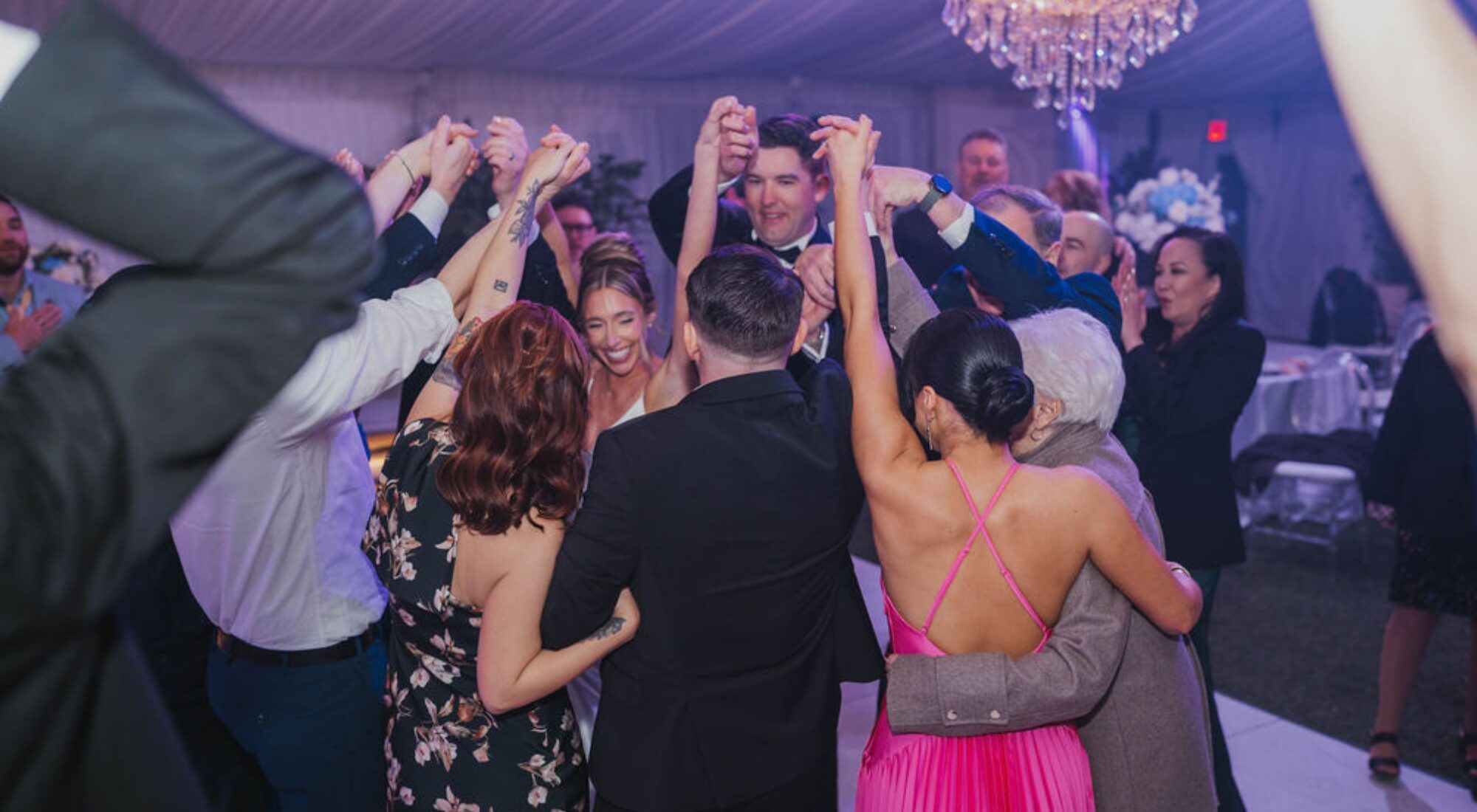
Okay, let me be honest with you. Planning a multicultural wedding in South Florida is one of the most exciting challenges you’ll face as a couple, and one of the easiest things to get wrong when it comes to entertainment.
I’ve seen it play out more times than I can count: the DJ plays an hour of reggaeton for the bride’s Cuban family, then abruptly pivots to Soca without a word to the crowd, and suddenly half the room is confused and sitting down. Or the MC only addresses the guests in English while half of abuela’s table has no idea what’s happening. The night fragments into two separate parties, and by 10pm, the dance floor looks like a geography lesson nobody signed up for.
A great multicultural wedding DJ does more than play different genres. The job is to build one cohesive night that everyone, from your tío who only dances to salsa to your college roommates who need Top 40 to feel anything, actually enjoys together.
Here’s exactly how to make that happen.
What to look for in a multicultural wedding DJ in South Florida
Before you start sending inquiry emails, get clear on your non-negotiables. For a multicultural wedding, that short list should include:
- Bilingual MC capability (English/Spanish at minimum for most South Florida weddings, with awareness of additional cultural languages and traditions)
- Documented multicultural experience, not just a claim that they “play everything”
- Collaborative playlist and timeline planning tools, not a DJ who just shows up with a laptop
- Backup equipment and a contingency plan in writing
That last one matters more than people think. A DJ who goes silent at your reception for 20 minutes because of a technical issue is a nightmare scenario, and it happens. Verified gear redundancy is a real differentiator.
“Multicultural” in practice means far more than swapping genres. It means the MC knows when to switch languages during toasts, the DJ respects the timing of cultural traditions (like a Colombian “hora loca” or a Haitian Compas set), and nobody’s grandmother feels left out because every announcement was delivered in a language she doesn’t speak. The goal is one cohesive night, not two separate parties sharing a venue.
Why bilingual DJ/MC capability makes or breaks the night
The DJ and the MC roles are distinct. Your DJ reads the room musically, managing transitions and energy levels. Your MC hosts the event verbally, guiding guests through the timeline, making introductions, and keeping the room informed and engaged. When those two functions are out of sync, or when only one language is used for announcements, things fall apart fast.
Imagine your Colombian grandmother sitting at Table 3 while every grand entrance, every toast introduction, every special moment gets announced exclusively in English. She’s physically present but experientially excluded. Now flip it: an English-only crowd trying to follow along when the MC switches entirely to Spanish for the second half of the night.
The fix isn’t complicated, but it requires intention. Bilingual MCs need to read the room in real time, deciding which moments get dual-language treatment and which can stay single-language based on who’s actually in the audience. The first dances, the toasts, the grand entrance, the cake cutting- those are the moments where bilingual delivery makes guests feel included rather than tolerated.
At Xpress Entertainment, our bilingual wedding DJs are genuinely fluent, not just holding a Spanish cheat sheet. Drew Segura, for example, is bilingual in English and Spanish and has spent years performing open-format sets that move between reggaeton, Latin pop, and Top 40 without losing the floor. That’s a skill set that takes years to develop, and it’s something you should specifically vet when interviewing any DJ for a culturally mixed event.
How we build your multicultural wedding music plan using the Vibo DJ app
Most couples don’t realize how much pre-event coordination goes into a smooth multicultural reception. It’s not enough to text your DJ a Spotify playlist two weeks before the wedding. You need a structured planning process that ties each song to a specific moment in the timeline.
The Vibo DJ planning app makes that process genuinely collaborative. Here’s how it works in practice:
You and your partner log in and start building your event timeline moment by moment: ceremony processional, cocktail hour background, grand entrance, first dance, parent dances, cake cutting, hora loca, open dancing, last dance. Under each moment, you pin specific songs, mark which tracks are must-plays versus do-not-plays, and flag any cultural traditions the DJ needs to be aware of.
Your Xpress DJ sees all of that in real time and can flag questions before the event, not on the wedding day. If your Trinidadian grandfather wants a particular Soca track played as the wedding party enters, and your partner’s family is expecting a traditional Spanish waltz for the first parent dance, those aren’t surprises, they’re already in the plan.
The app also helps manage requests on the night itself, giving your DJ context about which requests to take and which might disrupt the flow you’ve already built together. That kind of timeline-to-playlist coordination is what separates an average DJ from one your guests will actually talk about for years.
The multicultural wedding flow: moment by moment
Each part of the day calls for a different musical and hosting approach.
Ceremony: Keep it clean and culturally respectful. If you’re blending two traditions in the ceremony itself, choose music that honors both without forcing an awkward mashup. Classical or acoustic arrangements of meaningful songs tend to land universally. Your DJ should handle ceremony audio separately from the reception setup, with a wireless mic for the officiant and cued tracks for processional and recessional.
Cocktail hour: This is your first real opportunity to bridge the two sides of the room. Light Latin jazz, bossa nova, acoustic Afrobeats, or contemporary Caribbean sounds work well here because they’re pleasant without demanding attention. Guests are moving, mingling, and meeting each other, so the music is connective tissue, not a headline act.
Dinner and first dances: Sequence matters enormously here. The couple’s first dance sets the emotional tone. Following it with parent dances that honor each family’s musical heritage (a bolero for one family, a more contemporary song for another, for example) sends a clear message: both cultures belong here equally. Your DJ needs to pace these carefully, avoiding dead air between moments and never cutting a culturally significant song short.
Open dancing: This is where the real work happens. A skilled multicultural DJ doesn’t randomly switch genres every song. Instead, they build blocks, 20 to 30 minutes of Latin/Caribbean energy, then a crossover segment of shared crowd favorites, then a return to a specific tradition, then back to Top 40 peak-hour material. Guests get enough time in each genre to actually get comfortable on the floor. Read more about this in our guide to keeping the dance floor packed all night.
A sample multicultural set strategy you can customize
This is the framework most couples with Latin/Caribbean/Top 40 guest splits find works best. Adjust the blocks and genres based on your specific crowd.
Block 1 (Open dancing kickoff, ~30 min): High-energy Latin/Caribbean opening, reggaeton, salsa, merengue, or Soca depending on your family’s roots. This pulls the older Latin family members onto the floor early while the energy is fresh.
Block 2 (~25 min): Top 40/Hip-Hop/R&B crossover. Songs that both communities know and love, including current chart hits. Bridges generational gaps and brings the younger guests who’ve been waiting for their moment.
Block 3 (~25 min): Return to cultural roots with more specific genre depth, Kompa, Afrobeats, bachata, cumbia, or Soca. This rewards the guests who love those genres and shows cultural fluency, not just token representation.
Block 4 (Peak hour, ~30 min): Blend of all three, with the DJ reading the room to decide which direction to push. This is where crowd-reading skills matter most.
Final 15 min: Pull everyone together with 3 to 4 universal anthems everyone knows, then close with something meaningful to the couple.
Where DJs go wrong: random genre switches every two songs, cutting Soca or merengue tracks before they build, or ignoring that abuela danced the entire first block and sat down the moment the hip-hop started. A good set strategy acknowledges that both sides of the family deserve uninterrupted time on the floor, not just a token song or two dropped into someone else’s set. DJ Phil, for instance, is trilingual and open-format with 12+ years of experience specifically navigating these kinds of blended crowds.
Special moments and enhancements that elevate the night
Timing your production moments with your cultural flow matters. Cold sparks or a dramatic entrance effect land differently if they interrupt a quiet Bolero versus a peak-energy merengue set.
At Xpress Entertainment, our Epic Extras include:
- Dancing on the Clouds: a professional dry-ice machine creates a low-lying cloud effect for your first dance. It photographs beautifully and creates an instant memory regardless of cultural background.
- Cold spark machines: non-pyrotechnic, safe for indoor venues. Perfect timed to a grand entrance or a specific cultural moment where you want a visual exclamation point.
- Wireless uplighting and dance floor lighting: color-matched to your palette, with the option for club-style lighting during peak dance floor hours.
The key is planning these moments alongside your cultural timeline, not dropping them in randomly. A cold spark grand entrance that fires during a serious family toast is jarring. The same effect timed to the opening of your Soca block? That’s a memory.
South Florida considerations for multicultural weddings in Miami, Fort Lauderdale, Broward, and Palm Beach
South Florida isn’t a monolith. Miami venues operate differently than Broward county ballrooms, and Palm Beach estate weddings have completely different sound and logistics expectations than an outdoor reception in Fort Lauderdale.
A few practical realities:
The City of Miami Beach’s special events permit explicitly states that permits don’t override the city’s noise ordinance, and both Miami-Dade County and municipal noise rules apply. Outdoor receptions near residential areas often have hard curfews, sometimes as early as 10pm. Always confirm your venue’s specific sound cutoff with your DJ before you finalize the night’s timeline. Building your entire hora loca around an 11pm finish only to hit a 10pm noise cutoff is a real problem that local knowledge prevents.
Travel and setup timing also matter. A DJ managing gear for a Miami ceremony and a Coral Gables reception needs buffer time. When families are traveling from different places and the ceremony runs long (and it usually does), having a DJ who knows South Florida logistics and can adjust the timeline on the fly is genuinely valuable.
Xpress Entertainment serves Miami, Fort Lauderdale, Broward, and Palm Beach, with over 100 weddings executed annually across all four counties. Our Fort Lauderdale wedding DJ services and Miami wedding DJ pages cover venue-specific details for each area if you want to dig into local logistics.
Pricing and packages: what to expect and what to ask
Most competitors don’t post pricing online, which is frustrating. Here’s a transparent framework for what South Florida multicultural wedding entertainment typically costs:
A base DJ/MC package for a 5-hour reception typically starts around $1,500 to $1,800. Add ceremony audio (separate speaker/wireless mic setup), and that usually adds $200 to $400. Lighting packages, uplighting, monogram projection, or dance floor effects, run $300 to $800 depending on scope. Special effects like Dancing on the Clouds or cold sparks are add-ons typically priced per effect. Photo booth rentals add another $800 to $1,200 for a 3-hour window.
Full-production packages that bundle DJ/MC, ceremony audio, uplighting, and one or two special effects generally land between $2,500 and $4,000 for most South Florida weddings.
Questions you should ask any DJ before booking:
- What’s your backup plan if equipment fails? Do you carry redundant gear?
- How do you handle the MC role for bilingual crowds specifically?
- Can I see your planning process? Do you use a planning tool or app?
- Have you worked at my specific venue before?
- What happens if you’re sick or have an emergency on my wedding day?
- What’s your policy on last-minute song requests or cultural additions?
- Are you insured?
That last question is non-negotiable. Xpress Entertainment is fully insured, which many venues actually require.
Frequently asked questions
Do DJs handle music licensing, or does the venue?
Public performance licensing (through organizations like ASCAP and SESAC) is generally the venue’s responsibility, not the DJ’s. SESAC notes that “U.S. Copyright Law requires a Public Performance License for the use of live and recorded music.” Ask your venue directly if they hold valid performance licenses rather than assuming either party has it covered.
How far in advance should we book?
For South Florida weddings, 8 to 12 months is the norm for peak season (October through April). Summer dates have more availability, but popular DJs book up fast regardless. Don’t wait until 3 months out and expect your first choice to be available.
Can you handle ceremony music and bilingual MC announcements?
Yes. Ceremony audio is a separate setup from the reception, and any DJ you hire for a multicultural wedding should be comfortable handling the full arc of the day, processional through last dance. Bilingual MC service should cover all key announcements: grand entrance, toast introductions, first dances, and any cultural moments you want highlighted.
What if we need last-minute cultural additions to the playlist?
Using the Vibo DJ app, you can make additions right up to the event. The DJ sees changes in real time and can flag anything that might conflict with the existing timeline. Day-of requests are handled at the DJ’s discretion to protect the flow you’ve planned together.
Do you have backup equipment?
Xpress Entertainment carries backup equipment and has alternate DJ arrangements in place. Ask any DJ you interview to describe their specific contingency plan in writing.
Outdoor vs. indoor: how does that change things?
Outdoor receptions require weather-resistant speaker setups and careful attention to sound projection and direction. Noise ordinances at outdoor venues tend to be stricter. Confirm your venue’s curfew before building your timeline, especially if your crowd will be dancing past 10pm.
Where do you serve?
Xpress Entertainment covers Miami, Fort Lauderdale, Broward County, and Palm Beach. DJ Naqeeb, our Caribbean and West Indian specialist, is based in Miami and Fort Lauderdale, and is a strong match for weddings blending Soca, dancehall, Afrobeats, or Caribbean-rooted traditions with other genres.
Real wedding proof: what it looks like in practice
Miami (Coral Gables), Colombian/American wedding: The couple used the Vibo app to build a timeline that opened dancing with 30 minutes of cumbia and vallenato for the bride’s family, transitioned into Top 40 and hip-hop for the mixed-age American guest group, then brought it back for a Soca and reggaeton closing set. The MC delivered all major announcements bilingually. The dance floor stayed packed from 8pm to midnight.
Fort Lauderdale (waterfront venue), Haitian/Dominican wedding: This one required handling Compas alongside bachata and merengue, with distinct moments for each family’s traditions. The couple flagged two specific Compas tracks as must-plays during the Haitian family’s block. Cold spark machines fired during the grand entrance, and Dancing on the Clouds accompanied the first dance. Zero dead air between cultural segments.
West Palm Beach (estate venue), Cuban/Indian wedding: One of the more logistically complex blends, involving a bhangra-adjacent opening set for the groom’s side, a Latin set for the bride’s family, and an English/Hindi/Spanish bilingual MC throughout. The Vibo timeline was built weeks in advance, with the DJ checking in multiple times for cultural accuracy on specific tracks.
You can see reviews from real South Florida couples across venues here, including feedback specifically about multicultural planning and bilingual hosting.
Ready to build your multicultural wedding timeline?
The music at your wedding is the one element that affects every single guest, all night. Getting it right for a multicultural crowd means planning deliberately, not just hoping the DJ figures it out when the moment comes.
If you’re planning a wedding in Miami, Fort Lauderdale, Broward, or Palm Beach and you want to work with a DJ who actually has a process for this, check Xpress Entertainment’s availability for your date. We’ll start with a consultation, walk you through the Vibo app, and build a multicultural timeline that makes both families feel at home on the same dance floor.
That’s the goal. One night. Every culture welcome.