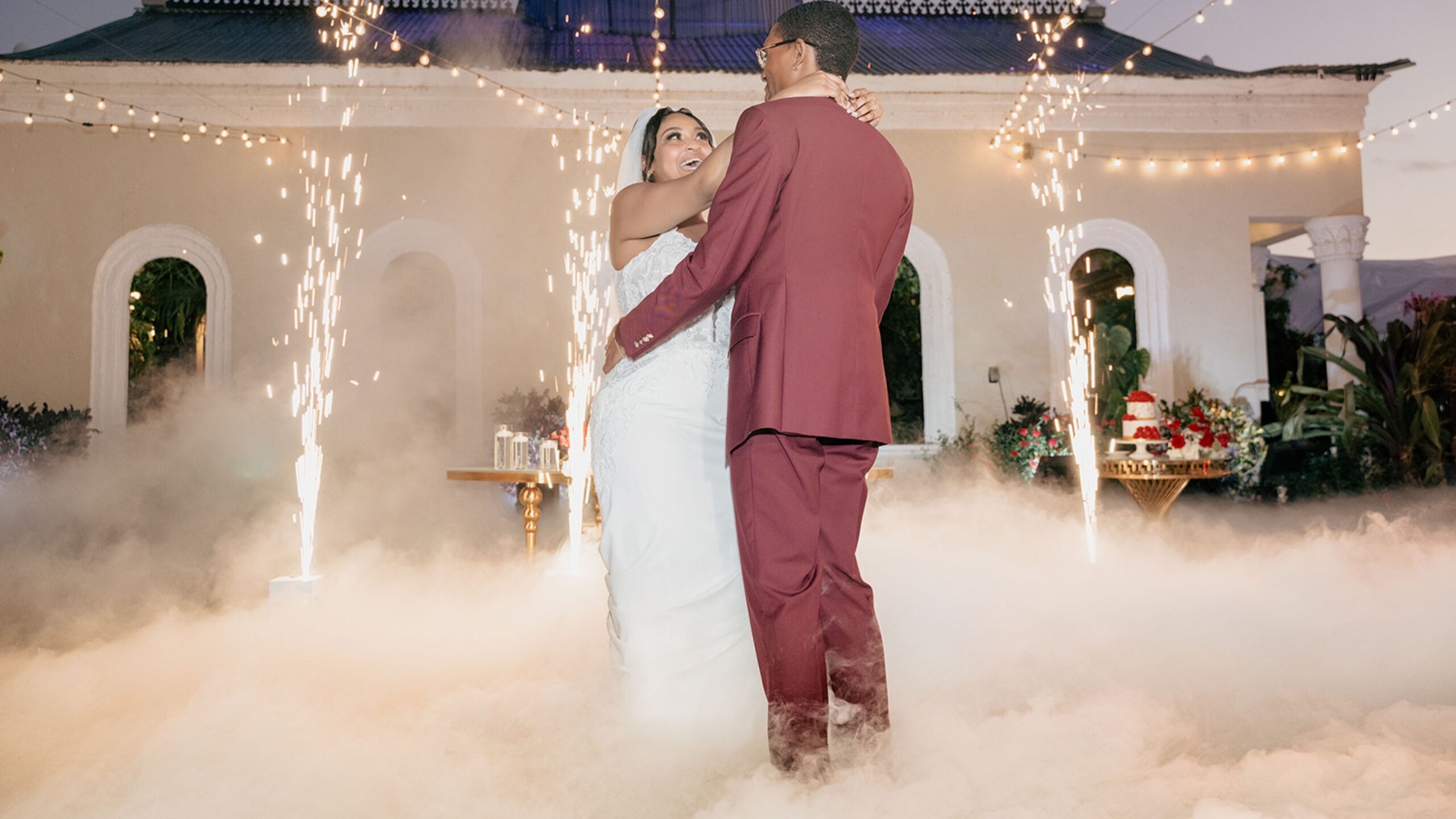
“Dancing on the clouds” is one of the most searched first-dance special effects for South Florida weddings, and for good reason. When executed correctly, the effect produces photos and video that couples genuinely keep on their walls. But there’s a wide gap between how the effect looks on a vendor’s social feed and how it performs on your actual wedding night, in your actual venue, in front of your actual photographer. This guide closes that gap.
What “dancing on the clouds” actually is for your South Florida first dance
The effect is a dense, low-lying layer of white vapor that hugs the floor at roughly ankle-to-knee height while you share your first dance. It surrounds the couple’s feet and the immediate dance floor without rising high enough to obscure faces, expressions, or the surrounding room. That’s the detail that makes it camera-friendly: your photographer can shoot straight through the cloud at eye level, and your faces are fully visible in every frame.
It’s used almost exclusively for the first dance (rather than the entire reception) because density matters. A properly produced cloud is thick and opaque for a defined window, not a thin haze that lingers throughout the night. You want impact for the moment, not a foggy reception hall.
One critical distinction: the effect must be produced with professional dry-ice or CO2-based low-lying fog equipment, not a standard fluid fog machine. Standard fog machines fill a room vertically and trigger smoke detectors far more reliably. Dry-ice low-lying fog stays near the floor because cold CO2 gas is denser than warm air. That physical property is what makes the effect work visually and what typically keeps it below the threshold of venue smoke detectors, though confirmation is still required. Xpress Entertainment’s dancing on the clouds service uses a professional dry-ice machine specifically for this reason.
How the effect works: dry ice + heated water produces the low-lying cloud
Dry ice (solid CO2) sublimates directly into gas when it contacts warm or heated water. Professional equipment controls the rate of sublimation and directs the resulting dense vapor across the dance floor through a distribution hose or nozzle. Because CO2 gas is heavier than ambient air, the cloud sinks and spreads horizontally rather than rising.
This behavior is what separates a true cloud effect from standard fog or haze machines. Haze machines use a heated chemical fluid that produces a fine, lightweight aerosol that floats upward and diffuses throughout the room. Dry-ice vapor stays low and dissipates cleanly as it warms and mixes with room air.
Duration is typically pegged to the first-dance song. Multiple South Florida vendors and industry guides confirm that the peak cloud effect runs for approximately 3 to 5 minutes under controlled conditions, which aligns well with a standard first-dance track. After that window, the cloud gradually thins as the dry ice depletes and the vapor warms. Planning your timing around this window is one of the most important logistics decisions you’ll make.
Dancing on the clouds vs. cold sparks vs. standard fog
Each effect serves a different visual purpose:
- Dancing on the clouds (low-lying dry-ice fog): Romantic, floor-level effect suited to the first dance. Soft and cinematic. Works especially well with slower, emotional songs.
- Cold sparks: Vertical fountain-style bursts of non-pyrotechnic sparks (titanium powder, not real fire). High drama, suited to a grand entrance, cake cutting, or a high-energy moment. Pairs well with the cloud effect since they occupy different visual planes.
- Standard fog machines (chemical haze): Room-fill effect used for atmosphere and lighting enhancement throughout a reception. These are handled differently by venues and are more likely to be restricted near smoke detectors.
The practical decision: if you want a single intimate moment on camera, the cloud effect alone delivers it cleanly. If you want multiple visual peaks throughout the night, pairing the cloud effect for the first dance with cold spark machines for a grand entrance or cake cutting creates distinct, memorable chapter breaks in your reception footage without redundancy.
What the effect typically costs in the South Florida market
The most commonly cited market range for “dancing on the clouds” as a standalone add-on is $200 to $450.
Actual pricing varies based on several factors:
- Equipment type and capacity (larger ballrooms may require more than one unit)
- Dedicated technician time for setup, operation, and breakdown
- Travel distance within South Florida (Miami-Dade, Broward, Palm Beach counties)
- Venue-specific requirements (some venues require insurance documentation before approving any special effects)
- Whether you’re booking it as a standalone rental vs. as part of a bundled entertainment package
Package pricing through a full-service wedding entertainment company generally differs from a standalone rental because the DJ/MC is already on-site and can cue the effect directly. That coordination has real value: the technician and DJ communicate in real time so the cloud peaks at the right musical moment, not 30 seconds before or after it.
Venue and safety checklist for South Florida couples
Before confirming any booking, work through this checklist with your venue coordinator:
- Venue approval: Ask specifically whether dry-ice low-lying fog is permitted. Don’t assume it’s covered under a general “special effects allowed” clause. Get written confirmation.
- HVAC and airflow: South Florida ballrooms run heavy air conditioning year-round. Strong ceiling vents directly over the dance floor can disrupt cloud height and density significantly. Walk the space with your vendor before the event to identify vent positions and adjust equipment placement accordingly.
- Smoke detectors: Dry-ice CO2 vapor is handled differently than chemical fog because it doesn’t contain smoke particles that trigger optical detectors. However, some venues have heat-sensitive or dual-sensor detectors that may respond to cold air near vents. Always confirm detector type with the venue and share that information with your vendor before the event. Do not assume low-lying fog automatically clears all venues.
- Floor safety and egress: The cloud should stay confined to the dance floor. A well-operated setup keeps vapor within the defined area and away from stairs, walkways, and emergency exits.
This checklist is worth sending in an email to your venue coordinator as a written record. A vendor who has performed the effect at South Florida venues across Miami-Dade, Broward, and Palm Beach counties should be able to provide standard venue approval language and insurance documentation on request.
Setup and timing: how technicians prevent a “clouds but not coverage” situation
The peak window (roughly 3 to 5 minutes) requires coordination between the technician and DJ. Here’s how the logistics typically flow on a wedding day:
- Equipment arrives and is staged during cocktail hour or dinner service.
- The DJ and technician confirm the first-dance song selection and identify the exact moment the cloud should reach peak density, usually a verse or two in or at a chorus.
- The technician begins loading dry ice and heating water approximately 1 hour before the first dance is announced.
- The MC/DJ cues the couple onto the floor, and the technician releases the vapor 20 to 30 seconds into the couple dance, allowing the cloud to spread before the cameras are focused on them.
- The technician monitors coverage and adjusts output direction throughout the song.
For larger ballrooms, two units positioned at opposite sides of the dance floor produce more even coverage than a single unit attempting to fill a wide space.
The Vibo DJ app that Xpress Entertainment uses for wedding timeline management is particularly useful here. Couples can specify song choices and mark the first-dance moment precisely in the app, and the DJ uses that timeline during the event to cue the technician with no guesswork involved.
How to make the effect look right on camera
Producing the cloud is one thing. Getting it on camera the way you imagined is another. A few specifics make a consistent difference:
Positioning: Stand in the center of the dance floor, not near the edge. The cloud density is highest in the middle of the distribution area, and standing there ensures both partners are surrounded evenly.
Lighting: White cloud against a dark room reads beautifully, but the effect improves significantly with color. Warm amber or soft white wedding uplighting around the perimeter of the room reflects off the cloud and adds depth to photos. Avoid colored gel uplighting that conflicts with the white of the cloud unless you’ve tested it with your photographer.
Song timing: Pick a song with a clear emotional peak, a moment where the music swells or a chorus hits. Brief your photographer on that section of the song so they know when to anticipate the best visual moment and can position accordingly.
Questions to ask any South Florida vendor before booking
Use these questions to evaluate any vendor offering this service in South Florida:
- What type of equipment do you use, dry-ice machine, CO2-based low-lying fog generator, or heated water system? How do you control cloud height and coverage area?
- What documentation do you provide for venue approval? Do you carry liability insurance, and can you supply a certificate of insurance on request?
- How many technicians do you bring? Who is responsible for cueing with the DJ/MC?
- How long does peak coverage last under your equipment configuration, and what environmental factors (HVAC, room size) affect that?
- Do you have examples of the effect executed at South Florida venues in Miami, Fort Lauderdale, or Palm Beach?
A vendor who can’t answer questions 2 and 3 clearly is a practical risk at your reception. The effect depends entirely on real-time coordination, and that coordination requires a dedicated person who isn’t also managing the DJ booth.
How Xpress Entertainment is set up for this moment
Xpress Entertainment serves couples across South Florida, including Miami-Dade, Broward, and Palm Beach counties, and executes over 100 weddings annually. The dancing on the clouds effect is part of the company’s epic extras suite, alongside cold spark machines, wireless uplighting, and photo booth options.
The practical advantage is integration. The DJ, MC, and effects technician are coordinated through one team rather than separate vendors operating on independent timelines. The Vibo app lets couples mark the exact first-dance song and flag key moments weeks before the event, so the timeline on the night is confirmed, not improvised.
Xpress Entertainment is also fully insured and travels with backup equipment as standard practice. For a South Florida wedding, where venue contracts often require proof of liability coverage before approving special effects, having that documentation ready is a meaningful logistical advantage.
For multicultural and bilingual celebrations across Miami and Fort Lauderdale, the bilingual DJ and MC team handles both language and cultural coordination throughout the reception, not just during the first dance. That continuity matters for transitions, announcements, and keeping family members across language backgrounds connected to the moment.
FAQ
How long does dancing on the clouds last? The peak effect typically runs 3 to 5 minutes, which aligns with most first-dance songs. Cloud density decreases gradually after the dry ice depletes. A single run is standard for the first dance; some couples book a second run for a grand entrance or final song.
Will it trigger smoke alarms or violate venue rules? Dry-ice CO2 vapor does not contain the smoke particles that trigger most optical smoke detectors. However, some venues have dual-sensor or heat-sensitive detectors. Always confirm detector type with your venue coordinator and share that information with your vendor in writing before the event. Most venues that allow the effect will want a COI from the vendor.
Is it safe for the dance floor? Is there a slip risk? The vapor itself is dry (CO2 gas, not liquid water) and doesn’t leave residue on dance floors. Equipment that uses heated water does involve warm water inside the machine, but a professionally operated setup keeps the moisture contained. The cloud disperses as it warms and doesn’t create condensation underfoot.
Can it be done for moments other than the first dance? Yes. Grand entrances and final songs are common uses. Each run requires a fresh dry-ice load and setup time, so additional runs should be planned and confirmed with your vendor in advance, not requested spontaneously during the reception.
How far in advance should I book? For South Florida peak wedding season (October through April), booking at least 3 to 4 months in advance is advisable. The effect is a popular add-on, and availability at specific venues with specific DJ/MC packages fills up. Securing the full entertainment package early ensures all elements, including the cloud effect, are confirmed and coordinated together rather than pieced together from separate vendors.